
Teslapologetics
Human drivers ≤ Tesla < Waymo. Also how cooked writers and mathematicians are (not and very, respectively).

(Post-Publication Prescript: Predictably, I’m getting pushback in both directions. “Why hand-wring about politics? Are the cars good or not?” And, “Any aid and comfort to Elon Musk is morally unacceptable.” To the second group, I hear you and feel kind of terrible and am sincerely working to offset the harm. To the first group, and especially any Tesla fans, consider: how much more powerful of a testimonial must this be if someone this biased against Musk was forced to this conclusion? But mostly, please read this as praising Tesla despite Musk, not because of him.)
Ok, yes, I have a Tesla now, but it’s not like that, I swear! (We peeled the Tesla logo off the front and have anti-Elon and “I’d rather be in a Waymo” stickers on the back. I live in Portland, Oregon and so feel compelled to mention these mitigations. But I’m serious about them. Read on.)
First, let’s, as the golems say, delve into my biases here. Remember when those kids got trapped in a cave in Thailand in 2018? And how Elon Musk got excited about building a mini submarine to rescue them but a diver helping with the rescue told him his idea was dumb and Elon flipped out and, seemingly in dead seriousness, accused the diver of being a pedophile? That’s when I first suspected that Musk was kind of a jerk. I continued to defend him for years though, on the grounds that he was clearly net-good for humanity, what with bringing the internet to the third world with Starlink, and seemingly singlehandedly making electric cars viable. (Not so much the Mars colony thing, but the rockets are still super cool.) Then he seemed to get more and more unhinged. I now genuinely believe he had some kind of psychotic break, maybe akin to what happened to his father around his age. Helping Trump get elected in 2024 was my last straw. I don’t know how to do the full moral calculus but “net-good for humanity” is at the very least not obvious here in 2026. (Yet more biases: I have good friends at Waymo. At least 3 if I’m not forgetting anyone.)
But if consumer cars with actual level 4 self-driving pan out, I’ll be tempted to say all is forgiven. At least if Trump is out of office by then and Musk forswears politics? The point is, Musk has been absolutely awful and completely shredded his credibility years ago. A couple months ago I talked about the blood he has on his hands from lying — and I do think it goes beyond his typical self-delusion, at least in that case — about the state of Tesla’s self-driving.
But the truth matters more than all of that, and the truth is, I’m now ready to say that I officially believe that Tesla’s self-driving — with a few huge caveats — is effectively between level 3 and level 4 autonomous. When I’m in the driver’s seat, despite being legally responsible for everything the car does, I personally believe it’s safe to take my eyes completely off the road for as long as the car lets me. Which is weirdly a lot, given that Tesla is legally required to use in-cabin cameras to ensure I’m paying attention.
Legally it’s still level 2 (human eyes on the road at all times) but I’m personally treating it as level 3+: eyes off the road unless the car the needs help, which I’m trusting it won’t need in real time.
The huge caveats
I want to get this in the boldest print possible because you may have seen videos of Teslas blasting past school buses and mowing down children (fake ones, but the Tesla sure didn’t know that) and think I’m a reckless idiot. Or any number of other horror stories. The Dawn Project, a bitter enemy of Tesla and Elon Musk, has been diligently documenting these. But even they admit that, despite extensively trying, they haven’t been able to get the new version of Tesla’s self-driving software to commit any vehicular homicides. Which brings us to the caveats:
The Tesla has to be “Hardware 4” (HW4), meaning produced in mid-2023 or later (seeing 2024+ as the model year means it’s definitely HW4).
The “full self-driving” (FSD) version has to be at least 14.
(If you have a slightly older Tesla, they still call the software “full self-driving” but, as of May 2026, it’s shameless lies.)
You have to keep the car in Sloth mode.
UPDATE: The car seems safe enough in the non-Sloth modes but only in Sloth does it obey speed limits. Here are a few more criteria I’d like to add out of abundance of caution:
It’s daytime and good weather.
The car is obeying Newton’s first law of motion.
I haven’t seen the car do anything immediately dangerous at night or in the rain but it might be more liable to get confused, like not proceeding when it should. And just having one more set of eyes on the road when it’s harder to see seems prudent.
The part about Newton is that any time you feel the car slowing, accelerating, or turning, go ahead and look up from your book as a sanity check. You won’t have to intervene in real time but the car has plenty of ways it can get confused and need an injection of human judgment. For example, it’s in an intersection and afraid to proceed and needs a nudge. This is rare enough but is one of the reasons you can’t fully go to sleep at the wheel yet.
I’m painfully aware of how ridiculous I sound. The aforementioned Dawn Project likes to show this graphic of the computing power of the different generations of Tesla hardware:
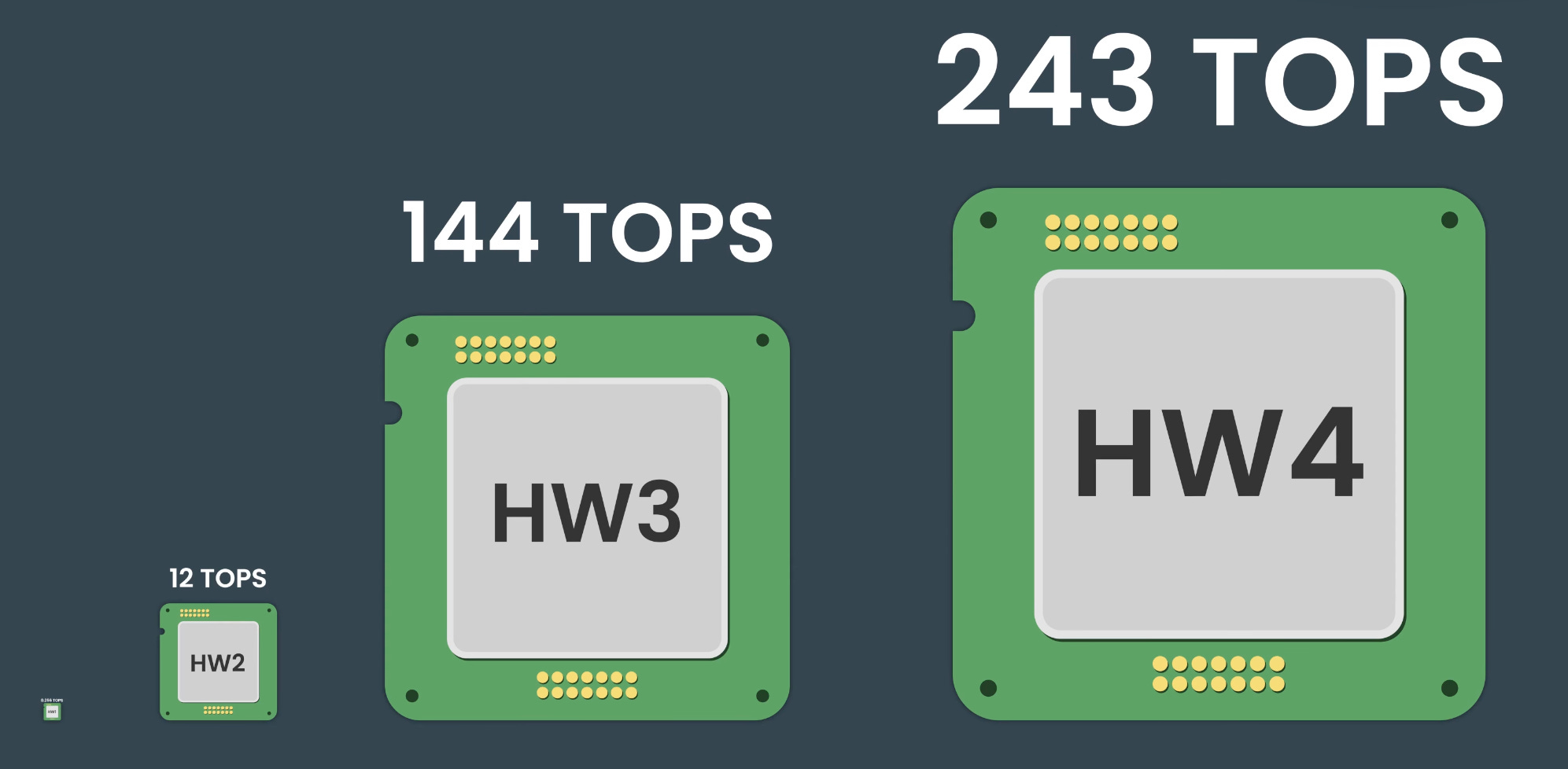
The tiny speck in the lower left is “hardware 1”. For every single generation of hardware, Musk has lied or deluded himself that it was enough to support unsupervised self-driving as soon as the software caught up. He sounds exactly the same every single time. Fool me once, shame on you; fool me twice, ok, you’re only human; fool me three times, and, yeah, how stupid do I have to be to believe this guy? He’s even talking already about HW4.1 and HW5 coming out next year. The pattern is pretty blatant.
So I’m not believing it because Musk said it. I’m not even believing my own eyes. I mean, yes, I’m personally blown away by having been driven thousands of miles by this car and never once having to intervene for a safety-critical reason. But, as I’ve been harping on in almost every AGI Friday about this, it’s all about the 9’s of reliability. A single human lifetime’s worth of driving isn’t enough data. I talk about this at length in the AGI Friday from January where I pooh-poohed the first intervention-free cross-country trip in a self-driving Tesla.
The 17 robotaxi incidents
One thing that changed last week is that we now have the details of every incident over the 2-ish million robotaxi miles Tesla’s accumulated in Austin over the last year. Back in February we knew of 9 of them (without details) and I reviewed them all and made my best guesses about fault. I came up with 3.45 at-fault accidents. Now we have twice as many incidents (over many more miles) and with enough detail to not have to guess (much) about fault.
For 6 of the incidents the robotaxi was stopped (for legitimate reasons) and hit by another vehicle. Plus 1 incident where the robotaxi was rear-ended while creeping forward at an intersection. There were 3 additional incidents with the robotaxi moving at walking speed, attempting unusual maneuvers where it hit a pole, a curb, and clipped its mirror on a tow truck, respectively.
Next are 5 incidents between 6 and 27 mph:
1. In October there was another case of a robotaxi clipping its mirror on the hitch of a dump trailer sticking into the road, this time at 18 mph. Not great but not quite safety-critical, I guess.
2. In September a robotaxi tried to turn into a parking lot and seemingly didn’t see a chain barring entry. It hit the chain at 6 mph.
3. Also last September, also at 6 mph in a parking lot, a robotaxi collided with another car that was backing out of a parking spot or maybe backing up the wrong way in a parking aisle. The robotaxi slowed and swerved and arguably had the right-of-way.
4. In December a robotaxi failed to avoid a pothole, hitting it with its rear tire at 17 mph and giving itself a flat. Then maybe the same tire hit a curb while it tried to pull over due to the flat. (The part about the curb could mean that the pothole problem has been more frequent but Tesla only had to report it due to making contact with the curb. That would match my experience.)
5. In September a dog darted into an intersection and a robotaxi braked and swerved but still hit it at 27 mph. That knocked the poor dog into the path of a van which also hit the dog but maybe it survived all that. It ran away, only to run back into the intersection. Maybe the dog was trying to commit suicide by Tesla?
Finally we have 2 hard-to-classify incidents:
In July, 2025, a robotaxi was stopped on the right side of the road, refusing to proceed. So the passenger-seat safety monitor requested a human teleoperator take control. They did and proceeded to drive the thing across the road, up a curb, and into a metal fence at 8 mph. Then in January, almost the same thing. A teleoperator took over, by request of the in-car safety monitor when the car was stopped, and skimmed a construction barrier at 9 mph, scraping up the car.
I was tempted to bump up my confidence in Tesla’s self-driving based on those last two. If the teleoperators are that inept then surely Tesla hasn’t been cheating with teleoperation to fake being at level 4 autonomy? On the other hand, knowing it’s even possible for the Tesla robotaxis to be remotely piloted that fast (in stark contrast with Waymo) means it’s been possible for Tesla to cheat.
But then I found a set of letters that all the autonomous vehicle companies sent to Senator Edward Markey earlier this year. (I’m presuming here that Tesla isn’t willing to outright lie to a congressperson.) It turns out the robotaxis are not remotely monitored in real time but can explicitly, when stopped, relinquish control to a teleoperator who can maneuver the vehicle at up to 10 mph. Waymo technically has a similar ability, limited to 2 mph (so below walking pace), in order to manually scooch the car away from a dangerous situation, and has never once used this ability in the wild.
In total, I’m counting 5-6 at-fault accidents, depending on how we count the pothole thing. Despite that one being likely more common than the data suggests, I don’t think of it as quite safety-critical so am inclined to be generous. And of course the software continues to improve at such things. (Parking is still pretty hit or miss, but also not safety-critical. I’m delighted it can do it at all.)
So I’m reasonably reassured by all that, but it’s still not actually enough data to be sure. If we compute miles between at-fault accidents and generate a probability distribution, we get this:
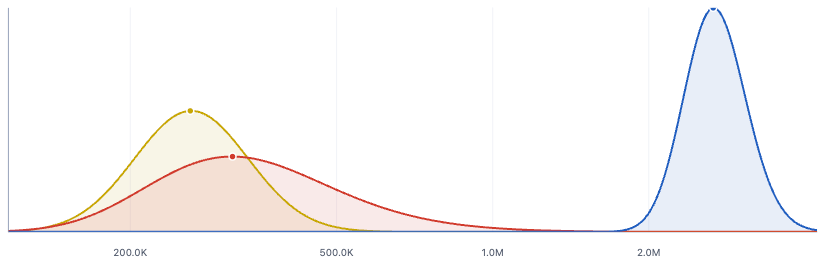
That’s humans in yellow causing an accident every 100-500k miles depending how you count, Tesla in red, and Waymo in blue with its millions of miles between at-fault incidents. Waymo you can absolutely trust with your life. For Tesla you might be inclined to want a bit more evidence.
Anecdata
I think we actually do have a fair bit more evidence. Namely, the extremely biased anecdata from all the YouTubers and Twitterers. Wait, hear me out. I’ve found some who I’m certain are honest, however biased they may be, and are assiduously posting all the most questionable FSD incidents they can find. And whether or not you trust these people, there’s a huge incentive to post the most egregious FSD fails you can, just because it’s massive clickbait. So for the versions of FSD starting with the Austin robotaxis last summer (see again the huge caveats above) we have many millions of miles with, I’m almost sure, zero instances of any injury-causing self-driving errors.
I rest my case? Not really, please argue with me. You might literally save my life.
A year ago this week
What was I saying in AGI Friday a year ago this week? “AI is getting frighteningly good at writing code.” Amen. Also that it
really feels like it’s on the path to AGI to me. If AI gets to a similar level for “go out and do such-and-such on the internet” as it’s currently at for “code up such-and-such”, that will start to get life-changing.
Well, the “code up such-and-such” has kept on accelerating but the “go out and do such-and-such on the internet” not so much.
Of course I was also talking about the Tesla robotaxis a lot a year ago, how Tesla’s about-to-be-launched robotaxis wouldn’t count:
I’m pre-committing to all the fine print and hopefully I won’t seem like a huge weasel when I explain how I was totally correct despite all kinds of fanfare about Tesla’s robotaxis.
Also I said this in a linked comment a year ago:
Tesla is making impressive progress but is not close to Waymo, and so they're aiming for the most restricted possible thing that they can still tout as technically a launch. Which may be perfectly fine and prudent, if they're honest about it.
Big if, but the truth is finally coming out and I’m as shocked as anyone how favorable for Tesla it is.
Can AI write serious literature?
I sure don’t think so, but news this week is that “The Serpent in the Grove” won a fancy writing contest and then was accused of being written by AI. To me this feels like more of an indictment of the judges. I read the story and oh my goodness the metaphors and similes:
his laughter like water over pebbles […] rum-shop leaned into the road like a rotten tooth […] the air sweet with cane and forgetting […] moved like heat through dry bush […] smiled like sunrise over a sink
It’s relentless. These remind me of that classic list of terrible analogies taken from high school essays. “Her hair glistened in the rain like nose hair after a sneeze.” Or, “John and Mary had never met. They were like two hummingbirds who had also never met.”
(UPDATE: Scott Alexander, quoting Nostalgebraist quoting Ginsberg, calls these things “eyeball kicks”.)
And of course good old “not X, it’s Y” makes an appearance. But just once, that I noticed (“It was not empty down there. It was waiting.”). Style aside, the plot was ok. I don’t think I would’ve clocked this as AI-generated — just crinkled my nose and rolled my eyes a lot. In retrospect it does have plenty of tells though.
So writers may not be cooked yet, but look what the poor mathematicians are dealing with…
Major open math problem solved by AI
Last week it was just “genuinely interesting open problems”. Things you might set a PhD student loose on. Now AI — not a highly specialized math AI, just an upcoming release of a standard golem — has solved what mathematicians confirm is a “major open problem”. Namely, the planar unit distance problem, posed by Erdős1 in 1946. It asks how to place n points on the plane in such a way as to maximize the number of pairs of points exactly 1 unit apart.
Erdős conjectured that it was impossible to do better than a linear function of n as n goes to infinity. Like how a simple grid of n points yields a bit less than 2n pairs that are 1 unit apart. Turns out Erdős was wrong. It’s possible to cleverly place n points such that, for big enough n, at least n^1.014 pairs are exactly a unit apart. Freaky.
The AI Haters, if they’re honest and consistent, should be predicting that the proof will not hold up. I’m predicting it will.
PS: The AI “merely” made the breakthrough that some exponent greater than 1 was possible. A human found that it works specifically with an exponent of 1.014. Nice for the humans to still have something to do, but presumably bad news if you were holding out hope that the AI proof wouldn’t hold up.
PSA: Erdős’s name is pronounced AIR-DISH. While we’re at it, Euler’s name is pronounced OILER.
That list is comedy gold. I'd somehow heard of "John and Mary had never met. They were like two hummingbirds who had also never met." before, but there's so many gems in there. A personal favourite: Her date was pleasant enough, but she knew that if her life was a movie this guy would be buried in the credits as something like "Second Tall Man."
I find the mixing of evaluation of a product with the CEO’s political views mostly irrational. Just buy good stuff (unless you think buying it is immoral e.g. the product of slave labor )