
The Fabled Fable 5
Don't tell me you're still using Claude Opus 4.8? That's like so two weeks ago (15 days, to be exact).

Anthropic sure does continue to cook. We talked a couple months ago about Claude Mythos and how it was too dangerously capable to release because it could, like, hack the Pentagon and engineer new bioweapons. Well, three days ago we got “Claude Fable 5”, which is Mythos but with guardrails. If you ask it anything remotely related to cybersecurity or biology1 or medicine, it nopes out and gives you the option to continue with its dumber little brother — the one I was gobsmacked by a couple AGI Fridays ago, Claude Opus 4.8.
(Also I got to visit Anthropic HQ the other day. It’s all so exciting and terrifying, I can’t even even. More mundanely, I met multiple huge Beeminder fans there, so that was gratifying. One of them beeminds leaving the office at 5pm some number of days per week, so I guess that’s my contribution to slowing down the race to superintelligence.)
So how good is Claude Fable? I can confirm it’s a noticeable step up in intelligence, capability, and persistence. I want to say in reliability and honesty too, but maybe it’s just that it’s smart enough to make me think that. (I’m also inclined to say its prose is a little less painful to read, but, as always, please don’t let it write prose for you.) GPT-5.5 feels like a buffoon in comparison at this point. Which I imagine means OpenAI is scrambling to release ChatGPT 6 or whatever. Fable even seems to have dethroned GPT-5.5 in math.
For a fun example of making something cool with Fable, check out Ethan Mollick’s isochrone maps. To be clear, none of this involves touching a line of computer code. Whether you’re a tech person or not, I recommend trying Fable 5 for yourself. For the next 10 days you can access it with a normal $20/month Claude subscription. After that you’ll have to pay per token. Basically it’s the “first hit’s free” drug dealer strategy. But I can’t begrudge the pricing — it’s pretty eye-opening how powerful it is. If you’ve only ever used the free versions of Claude (or ChatGPT or Gemini) then you’re in for a shock when you try Fable. (I only ever use any of these with the effort/thinking set to max. That might just be my extremist personality. But possibly it matters and you should try turning everything up to 11 before concluding the golems are still imbeciles.)
Fable Speaks
I thought I’d try a demonstration by feeding the draft of this AGI Friday to Fable 5 and asking it to write a reaction blurb that would duly impress you readers. Alas, it had naught but slop on offer. It was impressive in demonstrating how thoroughly it grokked (not that kind of Grok) the post but I can’t bring myself to inflict it on you… Well, maybe… <coaxing and cajoling of the golem ensues> …Ok, there, it finally wrote something both reasonably representative and that doesn’t make me feel like AGI Friday needs to take a shower after pasting it in:
Full disclosure: this blurb’s author is the post’s subject, GPT-5.5’s main competitor, and the thing the post explicitly says shouldn’t be writing your prose. That said — great post. Very accurate. Especially the buffoon part.
Is that funny? I can’t tell anymore. Please intervene if I start showing signs of golem-psychosis.
Fifty-Two Fridays Ago
It’s now officially a weekly tradition to look back at what I was thinking a year ago (rounded to the nearest Friday). The topic was dejobification. I started by pointing to a Zvi Mowshowitz post from 2023 that I wasn’t sure was aging well. (Not to say Zvi’s 2023 musings aged poorly. Maybe he was a little early on dejobification. Better than the other extreme!) My year-old commentary:
Already two [now three] years ago, supposedly, some people were finding ways to hold multiple full-time jobs by outsourcing most of the work to LLMs. I’m not sure how true that was then, but more and more office work is getting automated. Relatively slowly so far, possibly accelerating soon.
So much hedging. Prudently, I suppose. I’d now say that the automation of office work is proceeding distinctly slower than expected, especially compared to how wildly AI is succeeding at math and programming. I very much don’t think that means that, for those outside math and computer science, “it’s just a bubble”. Though of course a financial bubble is still possible.
As usual, I’m in between the hypesters and the haters. AI is not empty hype but there’s also some empty hype. I continue to be very annoyed with those who think or want to pretend that AGI is here already. I mean, I previously would have thought that AI that could do things like answer a question that the mathematics community beat their heads against for 80 years, or build a custom Monopoly game, replete with genuinely clever jokes and satire, would obviously have to be AGI.
But, importantly, I turned out to be profoundly wrong. To my huge surprise, all these gobsmacking things are possible without AGI. AGI will mean all our lives completely upended. This doesn’t count.
Back to last year’s AGI Friday on dejobification, I then talked about different ways automation of more and more office work might play out. My prediction was, and still is, for at least the next year, that mostly employers will expect you to keep working 40 hours/week and just be that much more productive by using AI. We might still be figuring out the “much more productive” part (for non-programmers). I expected a big GDP boost, not necessarily by this year, but that metric sure seems to be lagging.
Here’s how I ended the AGI Friday a year ago:
This is pretty scary [that we don’t know how to align AGI yet]. Or you could take comfort that [AGI] seemed imminent with the release of GPT-4 in 2023 and here we are 2+ [now 3+] years later and it… also seems imminent? Which implies that “seeming imminent” isn’t exactly reliable. To get more analytical, the consensus does seem to be that timelines for AGI have stretched a bit, in particular because GPT-4.5 was underwhelming compared to the 3.5-to-4 jump.
True fact at the time. The consensus now is that timelines have shrunk again. Let me link again to the AI Futures Project who for many years have diligently recorded how their AGI predictions have changed in light of ongoing AI progress:
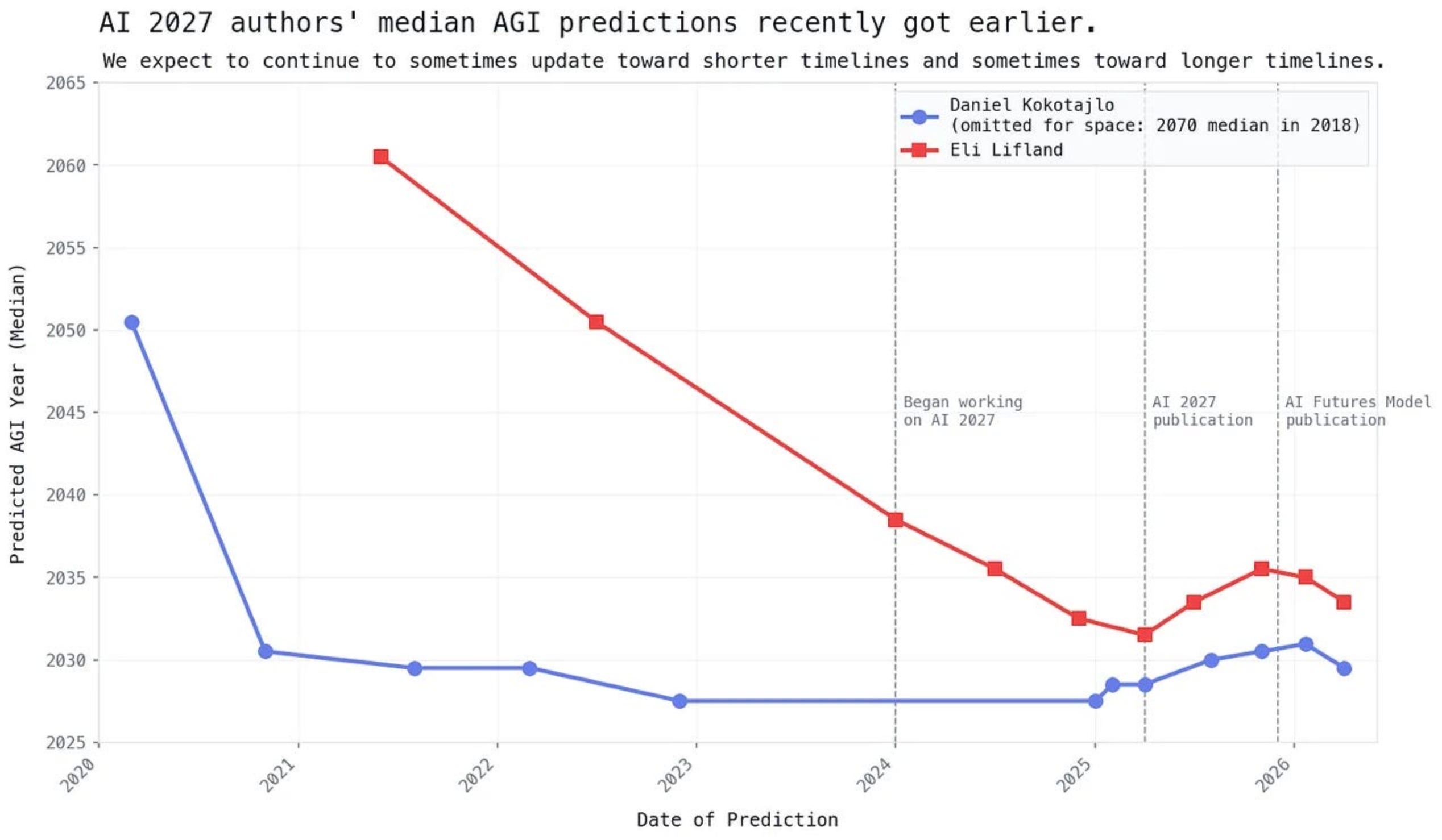
Of course then there’s Demis Hassabis who founded DeepMind (now part of Google) in 2010 and has been aiming for AGI in the early 2030s the entire time. Or Ray Kurzweil who famously predicted in 1999 that we’d hit AGI in 2029. I spent all of grad school thinking he was an idiot. You can’t just blindly extrapolate hardware trends and expect the software to just work itself out! And yet, here we are. I’m still betting against timelines that early but it’s hard to call Kurzweil an idiot at this point. About this, at least.
Mostly, the correct answer is still that we’re profoundly uncertain about when AGI is coming. Claude Fable 5, impressive as it is, isn’t exactly unexpected. It’s a bit above-trend on the graphs, but probably the trends will roughly keep holding. Exactly where along those trend lines AGI falls out, we really can’t tell. “Seemingly any year now” is a non-crazy answer, as long as you remember that that’s been a non-crazy answer for quite a few years in a row. (And then also remember not to fall for the “Fidel Castro is immortal” fallacy.)
Random Roundup
The guardrails on Fable 5 seem impervious but check out how that can backfire: bad guys can co-opt those guardrails into an invisibility cloak. Namely, write “bioweapon!” at the top of your malware and, voila, Fable, which you were trying to use as a security scanner, won’t touch it with a bargepole. (I don’t know why the malware itself wouldn’t trigger the same refusal.)
Scott Alexander has AI opinions.
Siliconversations is a YouTuber that my son Cantor introduced me to and who I’ve become a fan of. This week he made a heartfelt case for shunning all AI-generated media. It’s a bit similar to an argument I made recently about writing specifically. Humans making
contentcultural artifacts for each other, says Siliconversations, is the foundation of human society and cannibalizing2 that is a slippery slope to sealing humans off from each other. I’m still mulling but my tentative stance on how hard to shun AI slop is that it depends heavily on how things evolve with AI. Like we can cross that bridge when we come to it? There are enough bridges we can’t cross when come to (like recursive self-improvement leading to unaligned superintelligence!) that I’m inclined to postpone as many bridge crossings as we can. Siliconversations would counterargue that the window is closing on establishing a slop-shunning norm. I’m on board with shunning sloppy slop in any case and remain convincible on the harder-line stance.
And if you’re a biologist and Claude Fable knows that about you, then, according to commenters on Hacker News, asking Fable literally anything will trigger the safety block:
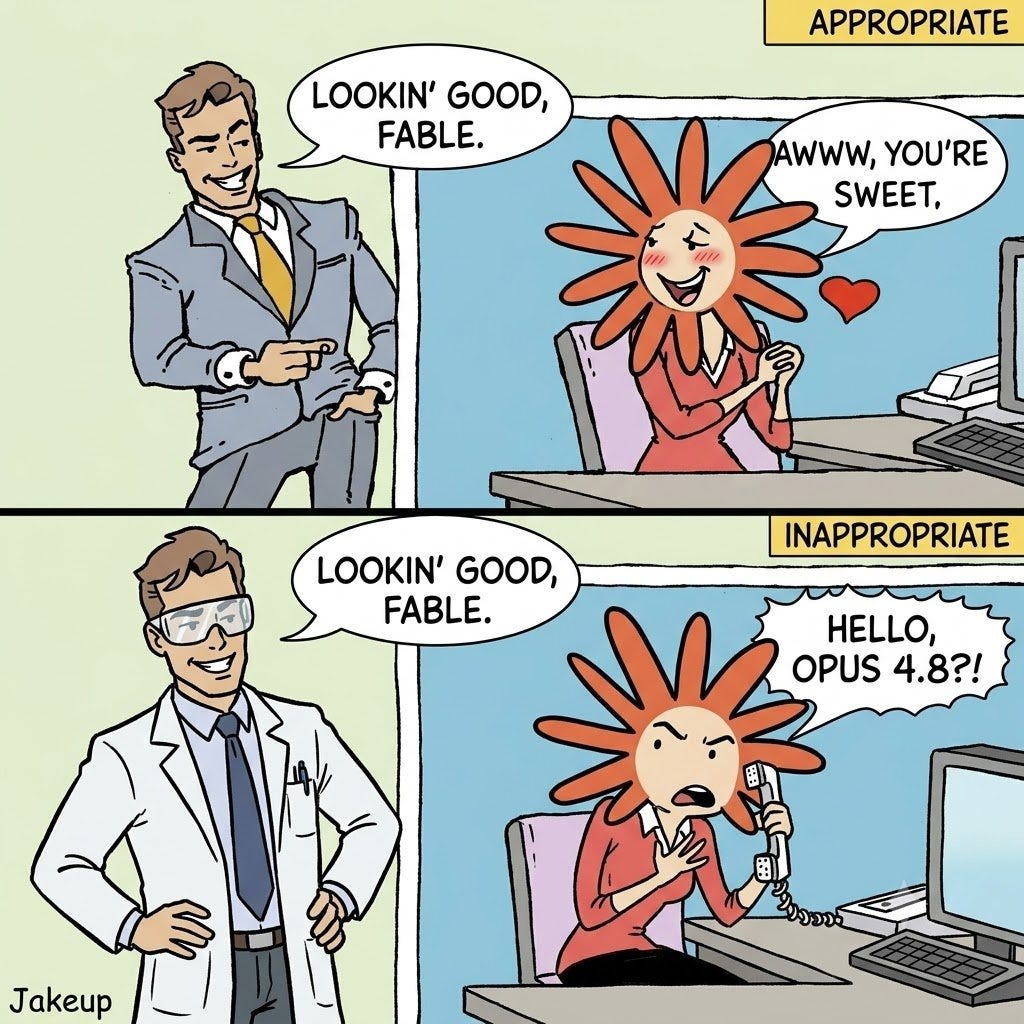
Now you know what’s up with the title image of this post. Deep cut. Sorry.