
Claude vs Monet
Claude, fittingly, is a better art snob than you. Also a look back at how wrong I was a year ago.

I immodestly think last week’s AGI Friday title, “This Is Not AGI, It’s an Ord Cloud”, was pretty clever but I’m embarrassed to admit that the “not X, it’s Y” stylistic parody wasn’t intentional. I noticed as soon as I hit publish. I did intend the “Ord Cloud” pun and was pleased to see at least one person get it and that I may have contributed to the metaphor catching on.
In this week’s whether-AI-is-about-to-hit-a-wall news, Scott Alexander has a nice humilitarian argument that people predicting that seemingly exponential AI progress is about to go sigmoidal are overconfident. He points out that extending lines on logplots has a great track record and “surely this will plateau soon” has a terrible track record.
And speaking of track records, let’s try a new AGI Friday feature where we look back at what I said 52 Fridays ago. The news that week was Google’s AlphaEvolve and whether it, a tiny bit, counted as recursive self-improvement. Here’s the first money quote:
If there’s no lull by early 2026, my own probability for AGI this decade is going to go up a lot.
So, yeah, very opposite-of-lull, and I consider AGI this decade to be entirely on the table, though still under 50% probability. I can’t decide how much under 50%.
I also spent a lot of that AGI Friday agonizing about being ambiguously overtaken by AI at math. That ship sure has sailed. Mathematician Timothy Gowers has an eye-opening description of where AI is at, math-wise, and what this means for math research now that AI is solving research-level problems, including genuinely interesting open problems. One year ago AI was solving tecccchhhhhnically open math problems but they didn’t count. This is a constant source of frustration in assessing AI news. Headlines like “AI solves open math problem” can mean so many different things. I think I was duly circumspect in my reporting a year ago, but you be the judge.
Here’s arguably the wrongest thing I said a year ago, about Tesla promising a launch of robotaxis in Austin the following month:
I won’t be surprised if there’s something they call a launch. But there will be humans in the driver’s seats. If the drivers don’t need to watch the road — i.e., level 3 autonomy — then we can quibble [about whether it counts].
The robotaxis launched on schedule, famously with empty driver’s seats, but as to whether it counted as level 4 autonomy, the debate is still raging. It still seems a bit closer to a demo than a product launch. And the passenger-seat safety monitors did have to watch the road. I still don’t know whether that’s a quibble. We might need another year to properly judge this one. I now believe Tesla is close, in a much more meaningful sense of “close” than what Elon Musk has meant for the last 12 years. I’ll go ahead out on the opposite limb from last year and say I expect to be able, at least, to safely read a book in the driver’s seat of a Tesla in 2026. Waymo still deserves all the glory though. I predict that when we eventually get hard data on Tesla’s self-driving, we’ll see that Waymos are safer. But if both are safer than humans, we can call that a quibble. (Waymos are already 10x safer.)
Breaking news: New NHTSA data is out today. Most interestingly, Tesla has unredacted all the descriptions of their robotaxi crashes. I’ll say more about this in a future AGI Friday but my impression so far is that this is a big positive update on how safe self-driving Teslas are. I’m seeing essentially zero instances of the car doing something blatantly unsafe. Exciting!
The Claude Monet Test
In excuses-to-include-a-pretty-image news, here’s a fun exercise: See if you can articulate why this “in the style of one of Monet’s paintings of water lilies” is slop:
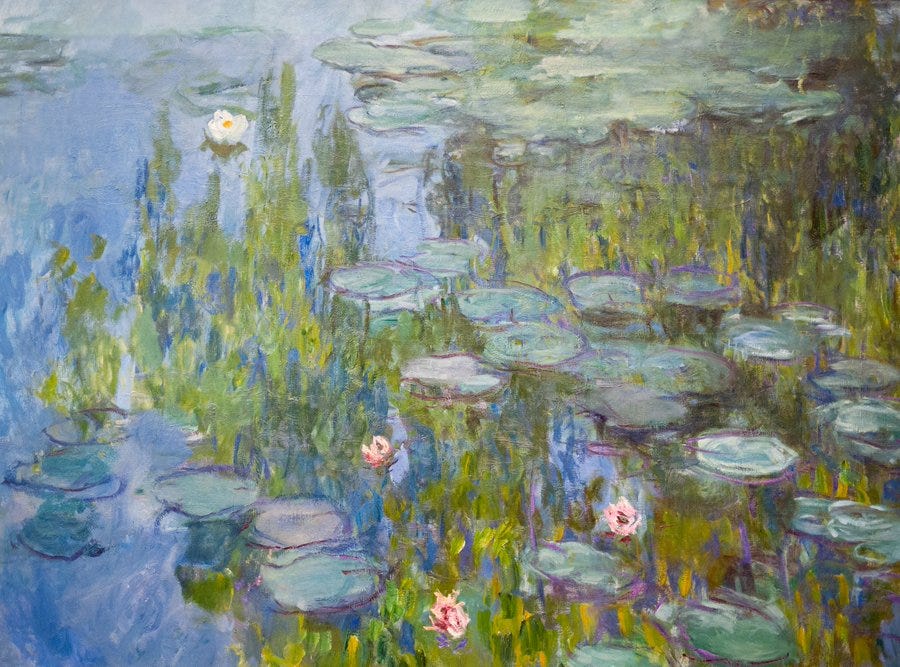
Go ahead and lock in your answer before reading further.
Here’s a maybe related experiment that Bryan Caplan ran on his blog. He posted two back-to-back versions of the same blog post: version 2 and version 1. One of them is AI-generated, mimicking Caplan’s style. It feels obvious to me which is which. I think the human one is excellent and the artificial one is, well, impressive for AI, and not even saying anything wrong that I noticed, but ultimately slop and fluff. I’m dismayed that Caplan’s commentariat can’t seem to distinguish them.
Claude’s Monet Reveal
Did you similarly wax eloquently about what a pathetic imitation of the human Monet that AI version is? You wouldn’t be alone. Here, ironically, is how Claude (um, the other Claude, Opus 4.7) responds to the question:
This doesn’t look like slop to me. It looks like an actual Monet, or a photograph of one.
The tells I’d expect from “in the style of Monet” generated slop aren’t here:
Lily pads have varied, irregular shapes and proper foreshortening — not the repetitive oval-stamp pattern generators fall into
The reflected foliage on the left has directional brushwork that actually tracks how a wet-on-wet stroke behaves, with hard edges where the brush lifted
Flowers are sparse and asymmetrically placed; slop tends to over-populate the surface with blooms because the prompt said “water lilies”
Visible canvas weave and impasto ridges, especially in the green reeds — surface texture that’s hard to fake
Color is muddied in the right places (the olive-grays where reflections meet pad shadows) rather than uniformly saturated
I say ironically because (in addition to Monet also being a Claude), the above analysis is, as Claude would put it, absolutely correct. I actually expected it to run with the framing of the question, as general AI sycophancy would predict, and fall for the trick, hallucinating a laundry list of reasons why the secretly-an-actual-Monet is an abomination. Turns out it’s the humans who do that. I mean, not me. But only because I don’t understand art and am 100% fooled by AI Monet forgeries.1 I cynically don’t even think the forgeries are worse in any objective aesthetic sense. Here’s one that a golem just regurgitated for me for comparison:

If anything I like it better. It’s a lovely AGI-Friday purple. (Robo-Claude of course eviscerates it.) I apologize to any art people for whom I’m causing physical pain right now. I don’t get it but at least I can relate. It’s writing that I’m a snob about.
Edited to add: To be clear, I wasn’t tricked into hallucinating reasons the Monet was slop only because I know that I know nothing. Presumably at the other extreme actual art experts wouldn’t be tricked either (I’d love to see the experiment run) and it’s just dilettantes on Twitter who were taken in.